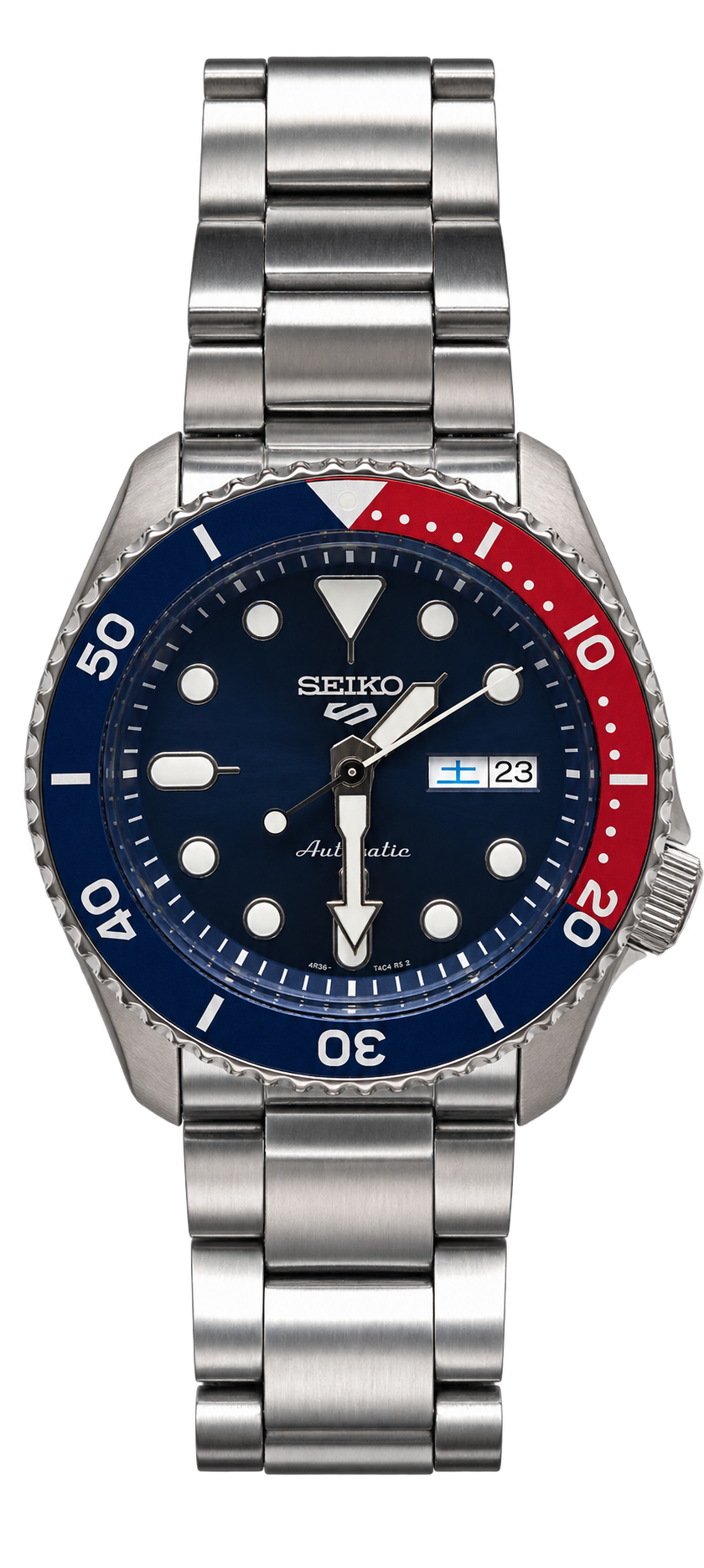
I did not set out to buy a 42.5 mm sports watch, according to Seiko 5 Sports SRPD53K1 review.
My original shortlist looked rather different. I was primarily searching for something between 37 and 40 mm, automatic, fitted with a conventional closed dial rather than a skeleton or open-heart design, and preferably paired with a steel bracelet. An exhibition caseback mattered to me because I wanted to see the movement without sacrificing the clarity of the dial. Sapphire crystal was another strong preference.
I spent a fair amount of time comparing Citizen, Orient and different Seiko references. On paper, the process was becoming increasingly rational: case diameter, lug-to-lug, movement, crystal, bracelet construction, water resistance and value.
Then I tried the Seiko 5 Sports SRPD53K1 on my wrist.
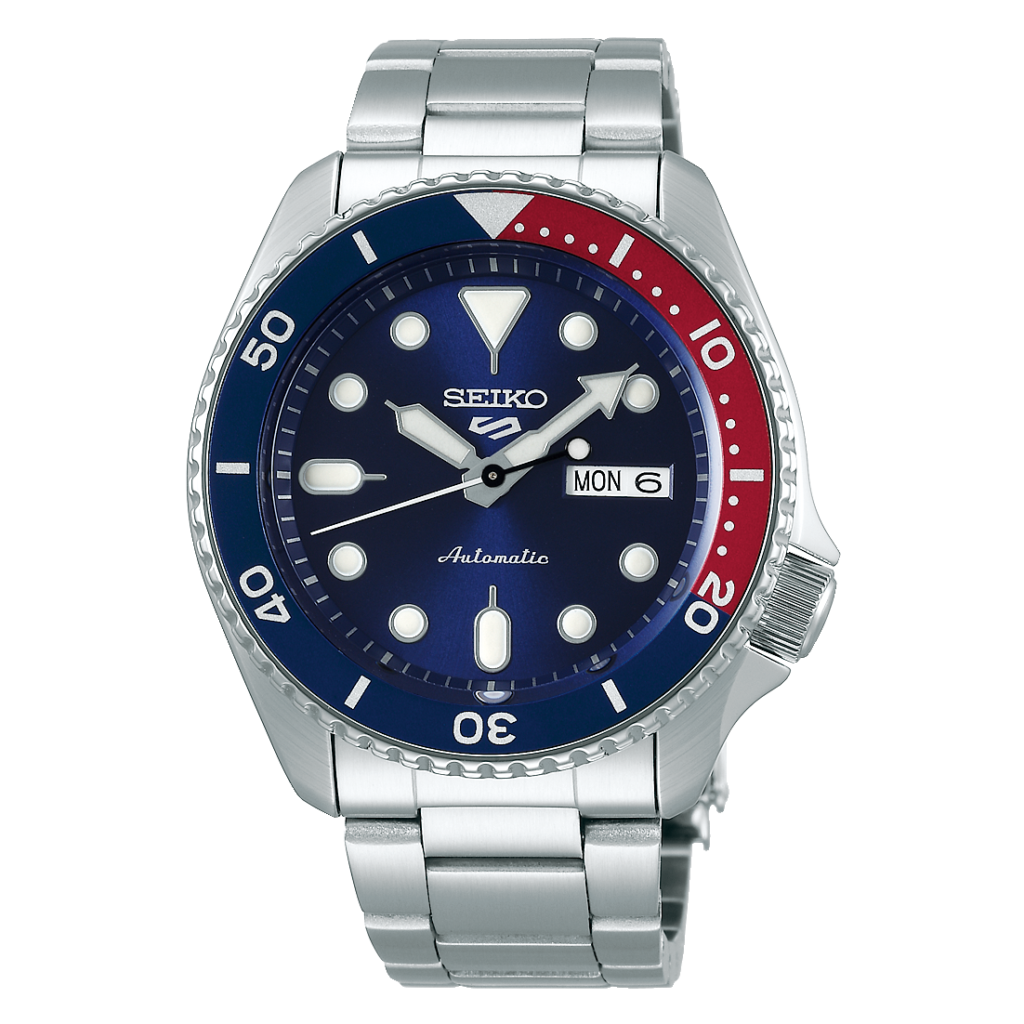
That changed the equation.
I eventually bought it from a Saat&Saat physical store in Türkiye for approximately TRY 17,000.
This review therefore comes from two perspectives. The first is technical: what Seiko actually delivers with the SRPD53K1, where the 4R36 movement sits in mechanical watchmaking, and how the dimensions, crystal, bracelet and general construction should be judged.
The second is more personal. What happens when those specifications stop being numbers on a product page and become part of something I actually wear?
That distinction matters. Specifications are excellent at eliminating unsuitable watches, but they cannot fully explain why one watch works on the wrist while another, theoretically superior one, does not.
First, the correct identity of the watch
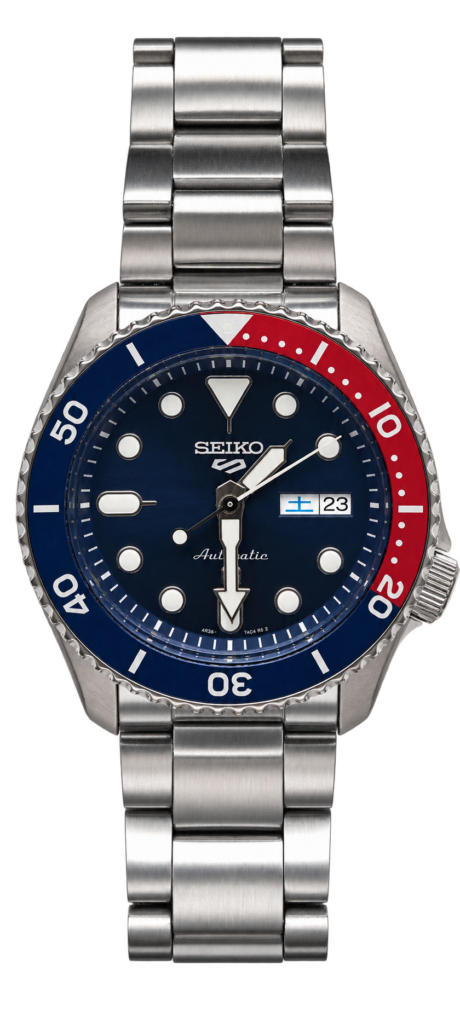
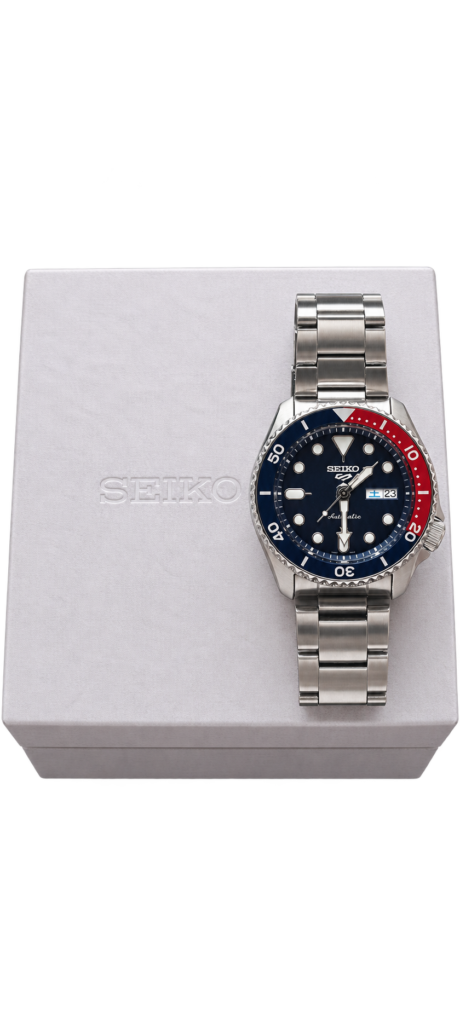
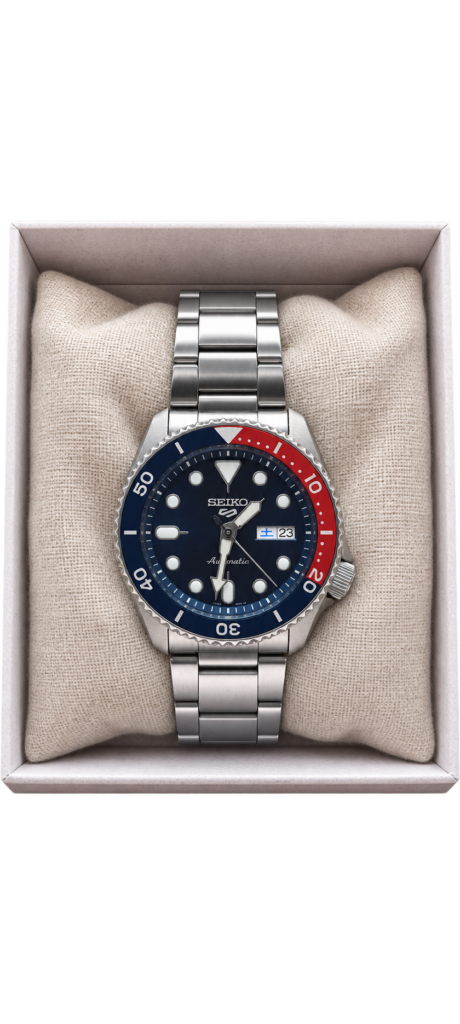
The watch is the Seiko 5 Sports SRPD53K1, part of Seiko’s SKX series. Seiko officially lists the model as SRPD53, while its product imagery identifies the physical reference as SRPD53K1.
The red-and-blue bezel means the watch is frequently called the “Pepsi” SRPD53 by retailers and enthusiasts. I think it is worth being precise here.
“Pepsi” is not an official Seiko edition name.
There is no Pepsi branding on the watch, and Seiko does not market it as a Pepsi Edition. It is simply an informal nickname borrowed from watch culture to describe the familiar red-and-blue bezel combination.
For that reason, I prefer to refer to the watch primarily as the SRPD53K1.
There is another distinction that deserves to be made immediately.
The SRPD53K1 is not a GMT watch.
The color combination may visually recall famous GMT watches, but there is no independent GMT hand and the bezel does not carry a 24-hour scale. Instead, it is a unidirectional 60-minute timing bezel. Seiko itself lists the watch with a unidirectional rotating bezel, not a GMT complication.
The appearance may borrow from a familiar color language; the functionality does not pretend to be something it is not.
Technical specification
| Specification | Seiko 5 Sports SRPD53K1 |
|---|---|
| Collection | Seiko 5 Sports |
| Series | SKX series |
| Calibre | Seiko 4R36 |
| Movement | Automatic with manual winding |
| Power reserve | Approximately 41 hours |
| Jewels | 24 |
| Frequency | 21,600 vibrations per hour / 3 Hz |
| Functions | Hours, minutes, seconds, day and date |
| Stop-seconds / hacking | Yes |
| Case material | Stainless steel |
| Diameter | 42.5 mm |
| Lug-to-lug | 46.0 mm |
| Thickness | 13.4 mm |
| Crystal | Hardlex |
| Water resistance | 10 bar |
| Bezel | Unidirectional rotating bezel |
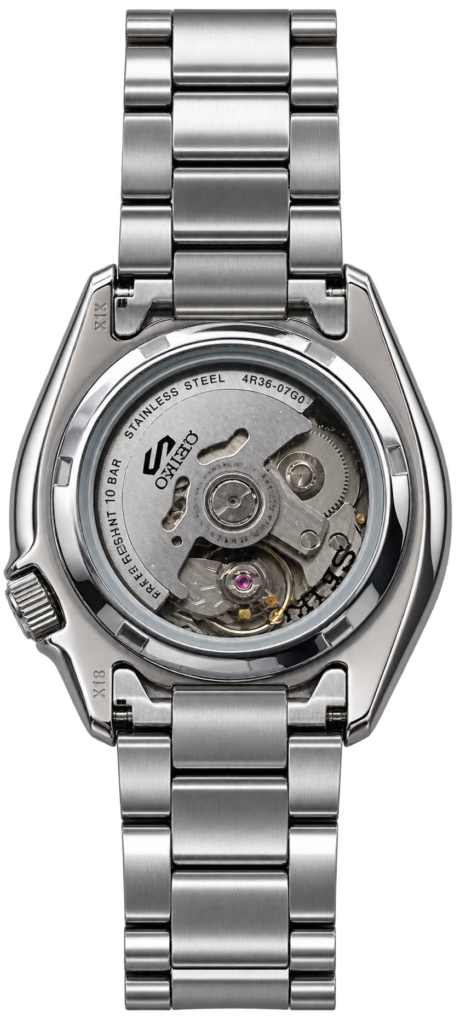
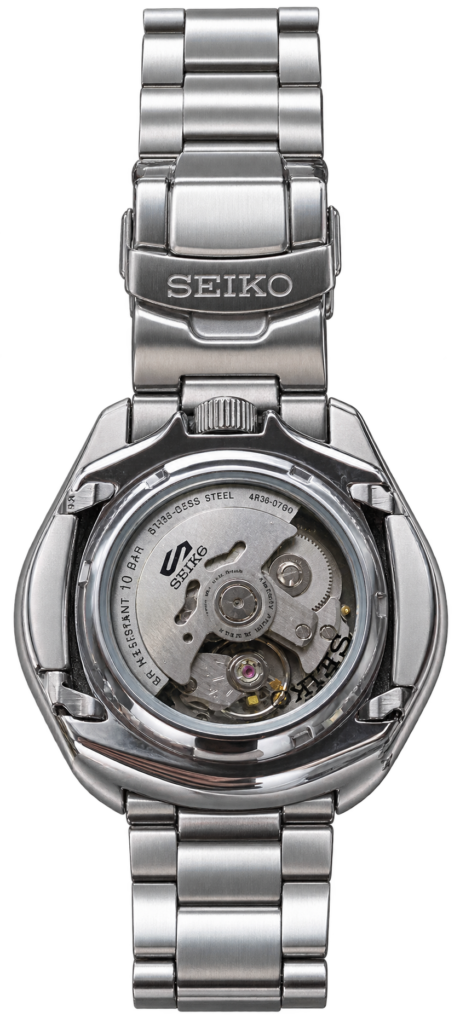
| Caseback | See-through screw caseback |
| LumiBrite | Hands and indices |
| Bracelet | Stainless steel |
| Lug width | 22 mm |
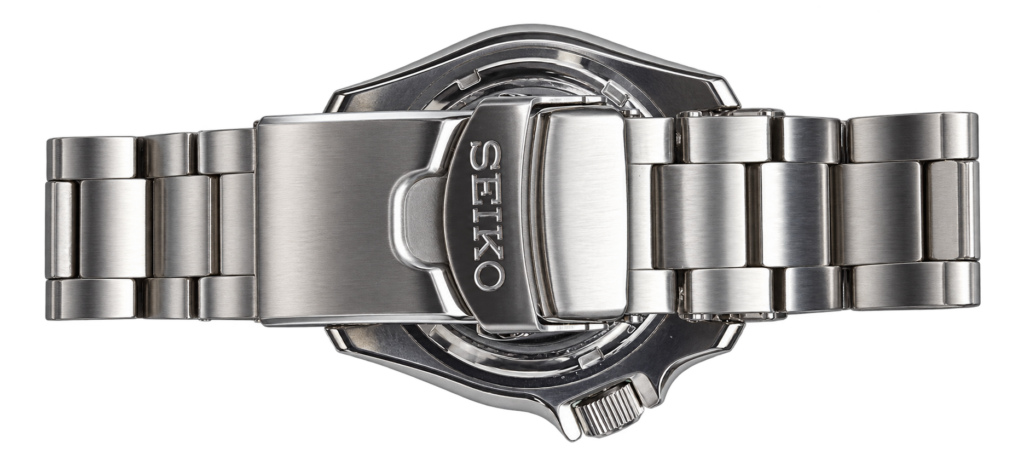
| Clasp | Three-fold secure-lock clasp with push-button release |
| Weight | 170 g |
Seiko’s official specification confirms the 4R36 caliber, with about 41 hours of power reserve and 24 jewels.
The movement features a 42.5 mm diameter, 46 mm lug-to-lug, and 13.4 mm thickness.
Hardlex crystal, 10-bar water resistance, 22 mm lug width, 170 g weight, a unidirectional bezel, and a see-through screw caseback.
This Seiko 5 Sports SRPD53K1 review notes the same specifications.
Understanding Seiko 5 before judging the SRPD53K1
The Seiko 5 name has significantly more history behind it than its current entry-level positioning might suggest.
The first Seiko 5, the Sportmatic 5, appeared in 1963. The concept established a practical formula built around automatic winding, day-date functionality, water resistance, a recessed crown position and durable everyday construction.
Seiko 5 Sports followed with a more overtly sporting identity.
That background is useful when looking at the SRPD53K1 because several elements that might initially appear to be simple styling decisions are actually connected to a long-running Seiko design language.
The crown sits around four o’clock. The day-date window occupies the traditional three-o’clock position. The indices are large and functional. The rotating bezel and protected case architecture clearly draw from Seiko’s sports-watch history.
The SRPD53 also belongs explicitly to the current SKX series within the Seiko 5 Sports family.
That does not mean it should be treated as an old SKX007 with a new movement.
The priorities are different.
SKX design language without pretending to be an ISO diver
The SRPD53K1 borrows heavily from Seiko’s diving-watch design vocabulary, but I would not describe it as a professional dive watch.
Seiko rates it to 10 bar water resistance. That is more than adequate for the sort of everyday exposure most owners will realistically subject it to.
The crown, however, is not screw-down.
The watch also uses a transparent caseback, reinforcing the idea that mechanical enjoyment and everyday use matter here just as much as pure tool-watch functionality.
I think the most accurate description is a diver-inspired mechanical sports watch.
That wording may sound less exciting than simply calling it a diver, but it places the watch in the correct context.
It has the visual confidence of Seiko’s sport and dive designs without claiming the same professional specification as the brand’s dedicated Prospex divers.
The red-and-blue bezel defines the personality
Without the bezel, the SRPD53K1 would still be unmistakably Seiko 5 Sports.
The red-and-blue combination is what gives this particular reference its strongest visual identity.
The association with the “Pepsi” color scheme is unavoidable, particularly because that combination has decades of history in GMT-watch culture. Yet on the SRPD53K1 the colors serve a primarily visual purpose.
The bezel remains a 60-minute timing bezel.
That difference matters to me. I prefer watches whose design and function remain intellectually honest. The SRPD53K1 uses a familiar combination of colors but never pretends to offer a GMT complication.
In person, the bezel is also less aggressive than some product photographs suggest.
The blue portion relates naturally to the dial. Indoors, the dial can appear relatively dark and restrained. Under stronger lighting, the blue becomes clearer and the red section adds contrast without completely dominating the watch.
That is one of the reasons the watch has been easier to wear than I initially expected.
It has personality, but it is not visually chaotic.
42.5 mm on paper, considerably more manageable on the wrist
This was the specification most likely to stop me buying the watch.
I had originally focused on watches between 37 and 40 mm.
The SRPD53K1 is 42.5 mm in diameter. Seiko also gives it a 46 mm lug-to-lug measurement and a thickness of 13.4 mm.
If diameter were the only measurement that mattered, the discussion would probably have ended there.
It does not.
The 46 mm lug-to-lug figure changes the wearing experience considerably.
Diameter tells us how wide the case is. Lug-to-lug tells us far more about how much of the wrist the watch actually occupies from top to bottom.
A 40 mm watch with long, straight lugs and a 50 mm lug-to-lug can feel larger than a 42.5 mm watch with compact geometry.
The SRPD case has relatively short lugs. The bezel also occupies a significant proportion of the visible surface, which prevents the dial itself from looking enormous. The crown position around four o’clock helps keep it away from the wrist when the hand bends.
The result is not a small watch.
At 13.4 mm thick and 170 grams on the steel bracelet, it clearly has presence.
But it does not wear like the 42.5 mm figure originally suggested to me.
That experience changed the way I evaluate watches.
Case diameter is important.
It simply should not be considered without lug-to-lug, thickness, dial opening, bezel proportions and bracelet integration.
Someone with a particularly narrow wrist should still try the SRPD53K1 in person before buying it.
That advice is more useful than pretending the dimensions work universally.
The dial prioritizes clarity
The SRPD53K1 is not trying to compete with a dress watch for delicacy.
The markers are large. The hands are broad. LumiBrite is applied to the hands and indices. Seiko confirms this directly in the model specification.
The day-date window at three o’clock takes up noticeable space.
From a purely minimalist perspective, I understand why some enthusiasts might prefer a cleaner date-only configuration. Removing the day display would create a more symmetrical dial.
I would still keep it.
The day-date complication is closely connected to the historical identity of Seiko 5, and in daily use it is genuinely practical.
Legibility is one of the strongest aspects of the SRPD53K1.
There is very little visual searching involved.
It behaves like a sports watch should.
Inside the case: the Seiko 4R36
The SRPD53K1 is powered by Seiko’s 4R36.
It is a 24-jewel mechanical automatic caliber running at 21,600 vibrations per hour, or six beats per second. It offers approximately 41 hours of power reserve, supports manual winding and includes a stop-seconds function. Seiko’s official product specification confirms the 4R36, automatic/manual winding architecture, 24 jewels, power reserve and stop-seconds function.
It also drives the day-date complication.
The mechanics are straightforward in principle.
Movement of the wrist causes the rotor to rotate. The automatic winding system transfers that movement to the mainspring, where mechanical energy is stored.
As the mainspring releases its energy, the gear train transfers it through the movement. The escapement meters that energy while the balance oscillates at a controlled frequency, creating the time base that allows the hands to advance.
There is no battery continuously powering this process.
If the mainspring eventually runs out of stored energy, the watch stops.
With roughly 41 hours of reserve, leaving the SRPD53K1 unworn for long enough will therefore require the watch to be restarted and, if necessary, reset.
The manual-winding capability makes that simple.
The stop-seconds function is equally useful. Pulling the crown into the time-setting position stops the seconds hand, which makes it possible to synchronize the watch against a reference time more precisely.
These are not luxury complications.
They are practical improvements that make a mechanical watch easier to live with.
A workhorse rather than haute horlogerie
The 4R36 deserves to be judged for what it is.
It is a widely used industrial mechanical movement focused on reliability, practicality and serviceability.
It is not a highly decorated movement.
It is not COSC certified.
It is not intended to demonstrate haute horlogerie finishing.
That distinction is important because the exhibition caseback makes the movement visually accessible. What you see is functional finishing, not an attempt at traditional high-end decoration.
I would describe the 4R36 as a workhorse.
That is a compliment, but also a boundary.
The exhibition caseback matters more than I expected
One of my original criteria was quite specific.
I did not want a skeleton or open-heart dial.
I wanted a conventional watch from the front and visible mechanics from the back.
The SRPD53K1 delivers exactly that.
Seiko officially specifies a see-through and screw caseback.
The transparent back provides a clear view of the rotor and part of the movement. Move the watch and the rotor responds immediately. Look more closely and you can see the balance operating.
The finishing is functional rather than decorative.
There are no elaborate polished bevels or high-end movement decorations to study.
That is not what this movement is about.
What the exhibition back provides is something more fundamental: visual access to the fact that the watch is a machine.
I have found myself turning the watch over simply to watch the rotor move.
That sounds trivial until you own a mechanical watch.
For someone becoming increasingly interested in how these objects work, it changes the relationship with the product.
The mechanism is no longer an abstract specification hidden behind steel.
You can see it doing its job.
Hardlex: acceptable, but still my clearest criticism
The SRPD53K1 uses Hardlex rather than sapphire crystal. Seiko confirms Hardlex as the factory crystal for the model.
Hardlex is Seiko’s hardened mineral crystal solution.
It should not be treated as ordinary untreated mineral glass, but it should not be described as equivalent to sapphire either.
Sapphire is substantially harder and significantly more resistant to everyday scratching.
Hardlex trades some of that scratch resistance for a different balance of impact behavior, manufacturing cost and practical sports-watch durability.
There is logic behind the choice.
I still would have preferred sapphire.
At approximately TRY 17,000, this is the specification I question most.
Citizen and Orient both offer automatic watches in adjacent segments where sapphire can be found, so the comparison is difficult to avoid.
Hardlex has not reduced my enjoyment of the SRPD53K1.
I do not treat the watch as a fragile object.
But I am more conscious of abrasive contact than I would be with sapphire, particularly because I expect to own the watch for a long time.
If I could change one specification without altering the personality of the watch, this would be it.
The bracelet is practical before luxurious
The stainless-steel bracelet fits the visual character of the SRPD53K1 well.
Its broad three-link construction supports the sports-watch aesthetic and balances the visual weight of the case.
It is sometimes casually described as Oyster-style because of the general three-link layout, although “three-link steel bracelet” is the more neutral description.
Once sized correctly, it distributes the mass of the watch reasonably well.
The secure three-fold clasp with push-button release is uncomplicated and functional. Seiko lists a three-fold clasp with secure lock and push-button release, along with a 22 mm lug width.
Where I become more critical is refinement.
The bracelet does not provide the level of articulation, clasp sophistication or finishing that becomes noticeable on more expensive watches, and some aggressively priced competitors can also feel more refined in this area.
The bracelet works.
It is not the reason I bought the watch.
That distinction summarizes it fairly well.
Can it be worn with a suit?
Yes, with some context.
I would wear the SRPD53K1 with a navy suit, white shirt, pale-blue shirt, blazer, tailored separates, chinos or contemporary business clothing.
The blue dial helps considerably.
The steel bracelet also integrates naturally with modern office wear, while the red section of the bezel is small enough not to turn the watch into an obvious statement piece.
I would not choose it for black tie.
With a tuxedo, a highly formal evening event or traditional formal dress, I would prefer something smaller, thinner and visually quieter.
That does not mean sports watches cannot be worn with tailoring.
Modern professional dress is far less rigid than that.
The more useful concept is formality matching.
The SRPD53K1 works well from casual through smart business and into ordinary business-formal environments.
Its limits become clearer when the occasion moves towards ceremonial formality.
My ownership review: where the specifications stopped being theoretical
This is the part I could not have written before buying the watch.
I originally thought 42.5 mm would be the problem.
It has not been.
The 46 mm lug-to-lug measurement and compact geometry matter far more in real use than I expected. The watch still has presence, and I would not call it understated, but I do not experience it as the oversized watch the diameter suggested on paper.
I also thought Hardlex might become the reason not to buy it.
It remains a compromise.
I would still choose sapphire if Seiko offered this exact configuration with it.
But it has not become an obstacle to wearing or enjoying the watch.
The bezel raised another question.
Would the red-and-blue combination feel exciting for a week and excessive afterwards?
So far, the answer has been no.
If anything, it is the feature that prevents the watch from becoming another anonymous blue-dial steel sports watch.
The exhibition caseback has also justified its place on my original requirement list.
Watching the rotor has not become irrelevant after the first few days. It still reinforces the mechanical nature of the watch in a very direct way.
And the 4R36 has behaved conceptually exactly as I wanted it to.
It is neither exotic nor delicate.
I can wear the watch, let the rotor wind it, manually wind it when required and hack the seconds hand when I want to set it accurately.
The mechanical system is present without making the ownership experience unnecessarily complicated.
Mechanical accuracy requires a different mindset
One adjustment when moving from quartz into mechanical watches is accepting that accuracy works differently.
A quartz watch can outperform the SRPD53K1 by a considerable margin in pure timekeeping accuracy.
A smartphone makes the comparison almost meaningless.
That does not mean mechanical accuracy should escape criticism.
It means the engineering objective is different.
The 4R36 relies on a physical oscillator whose behavior changes with position, temperature, state of wind and usage conditions.
Part of owning a mechanical watch is learning how your particular movement behaves.
That is interesting.
It is not an excuse for poor regulation.
Both ideas can be true at the same time.
Where does the SRPD53K1 sit in a collection?
I do not think of the SRPD53K1 as an investment watch.
A watch can be meaningful in a collection without being a speculative asset.
For me, the SRPD53K1 makes more sense as a collection anchor.
It is robust enough to wear frequently, recognizable enough to represent a clear part of Seiko’s modern design language and mechanically interesting enough to sustain attention beyond the initial purchase.
It also makes considerable sense as a first serious automatic watch.
It introduces the owner to automatic winding, manual winding, power reserve, mechanical rate variation, hacking, day-date adjustment, rotating bezels, LumiBrite and exhibition casebacks in a single package.
There is also a large aftermarket ecosystem around Seiko 5 Sports.
Replacement bracelets, bezels, inserts and sapphire crystals are widely available.
I would personally avoid modifying a new watch immediately.
Originality matters to me, and modifications can affect warranty, water resistance and future servicing.
But the size of that ecosystem says something about the level of enthusiasm surrounding the platform.
Was approximately TRY 17,000 a sensible purchase?
I think it was reasonable.
I do not think it was unbeatable.
That difference is important.
The SRPD53K1 does not win every specification comparison around its price.
A Citizen may offer sapphire and a more refined urban bracelet.
An Orient may offer a different balance of movement, crystal and water resistance.
A pre-owned purchase can completely change the value equation.
If the objective is to maximize the number of specifications per Turkish lira, there are scenarios where the SRPD53K1 loses.
What I received for roughly TRY 17,000 was something broader than that comparison.
I received a current Seiko 5 Sports with the 4R36, a distinctive SKX-series design, 10-bar water resistance, excellent legibility, a steel bracelet, an exhibition caseback and an opportunity to inspect the actual watch on my wrist before buying it from a physical retail channel.
That physical trial mattered.
It is the reason I bought a 42.5 mm watch after spending weeks insisting I wanted something smaller.
I still want sapphire.
I still think the bracelet could be better.
I would prefer tighter factory regulation.
Owning the watch does not make those criticisms disappear.
Nor should it.
A purchase review becomes much less useful when it turns into an attempt to justify money already spent.
What I like most
- Case proportions: 42.5 mm sounds large, but the 46 mm lug-to-lug makes it much more manageable than expected.
- The 4R36: straightforward, robust and practical, with manual winding and hacking.
- Exhibition caseback: it adds genuine value to the ownership experience without compromising the clean dial.
- Red-and-blue bezel: distinctive enough to give the watch personality without pretending to be a GMT.
- Legibility: large indices, clear hands and LumiBrite suit the character of the watch.
- Seiko identity: it looks unmistakably connected to Seiko rather than like an anonymous imitation of another brand.
What I would change
- Sapphire crystal: the clearest specification upgrade I would want.
- Bracelet refinement: better articulation and clasp execution would strengthen the overall package.
- Tighter movement regulation: the 4R36 is reliable, but chronometric performance is not its strongest selling point.
- A screw-down crown: not necessary for everyday ownership, but it would better match the tool-watch aesthetic.
- A smaller alternative: the current proportions work surprisingly well, but a factory version closer to 39–40 mm would be extremely appealing.
Final assessment
| Area | Assessment |
|---|---|
| Movement | A dependable workhorse with manual winding and hacking, but not a high-precision or highly decorated calibre. |
| Design | Strong Seiko identity with an effective red-and-blue bezel and recognisable SKX-series architecture. |
| Ergonomics | Considerably better than the 42.5 mm figure suggests because of the compact 46 mm lug-to-lug. |
| Legibility | One of the strongest aspects of the watch. |
| Bracelet | Functional and visually appropriate, although finishing leaves room for improvement. |
| Crystal | Hardlex is defensible, but sapphire would materially improve the package. |
| Everyday use | Strong. The combination of steel construction, day-date, 10-bar water resistance and a simple automatic movement is easy to live with. |
| Collector interest | More compelling as an enthusiast’s everyday Seiko than as any form of speculative investment. |
| Value | Reasonable as a complete ownership package, even though competitors can outperform it on individual specifications. |
Closing thoughts
If I had judged the Seiko 5 Sports SRPD53K1 only against the criteria I established before walking into the store, I probably would not have bought it.
It was larger than my target.
It used Hardlex instead of sapphire.
Its sports-watch architecture was further from the elegant, compact watches I had initially been researching.
Then I wore it.
The 46 mm lug-to-lug made the 42.5 mm case considerably more manageable than expected. The blue dial and red-and-blue bezel looked more balanced in person than they had on a screen. The exhibition caseback delivered exactly the kind of mechanical involvement I had wanted from an automatic watch.
None of that changes the weaknesses.
Hardlex remains Hardlex.
The 4R36 does not become a chronometer because I own one.
The bracelet does not suddenly acquire luxury-level finishing.
And the SRPD53K1 should not be mistaken for a professional ISO diver simply because it carries familiar Seiko sports-watch design cues.
Those compromises are part of the watch.
What changed was my understanding of their importance relative to the complete experience.
The SRPD53K1 did not win my search by dominating a spreadsheet.
I bought it because the movement, proportions, design, mechanical character and physical wearing experience made sense together when the watch was actually on my wrist.
That has probably been the most useful lesson from buying it.
Technical specifications should survive scrutiny.
But if specifications told the entire story, there would be very little reason to try a watch on before deciding whether it belongs on your wrist.